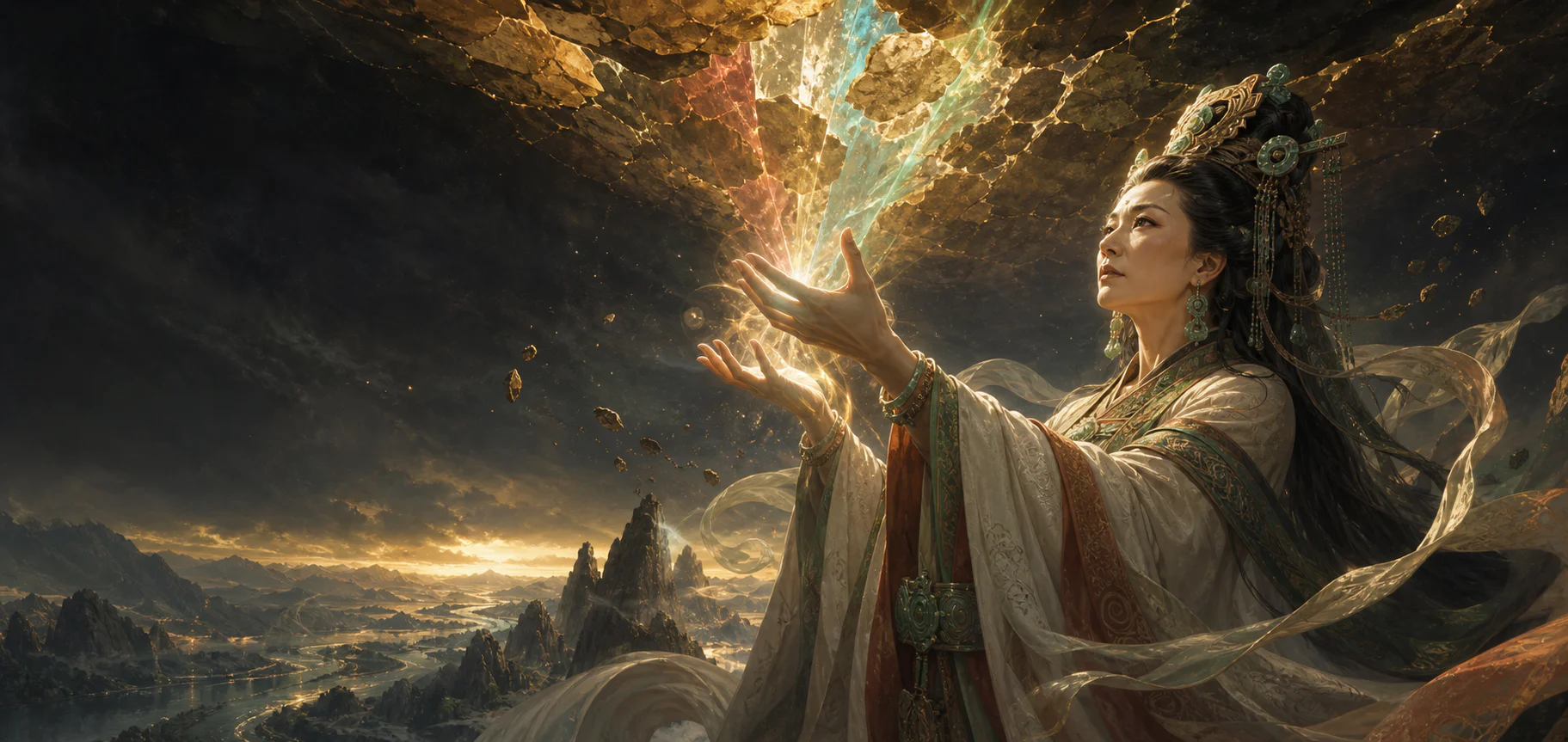
CIVILIZATION DOSSIER
Nüwa女娲娘娘
An ancient goddess who melted stones to repair the sky. Because King Zhou blasphemed her, she sent three demons to bring disaster upon the Shang dynasty.
- DIRECT FIGURES
- 9
- RELATION RECORDS
- 13
- SOURCE WORKS
- 7
RELATIONSHIP COMPASS
Nüwa, and the people around them.
Open one chapter at a time. Each chapter gives the relationship first, then the source text behind it.
01CONFLICTConflict
Battles, captures and defeat
4 figures · 4 records+
Conflict
Battles, captures and defeat
King Zhou (Di Xin)→Nüwadesecrate
Nüwa→Dajicatch
Nüwa→Nine-Headed Pheasant Spiritcatch
Nüwa→Jade Pipa Spiritcatch
02THE UNSEENMythic acts
Transformation, aid and divine punishment
9 figures · 9 records+
Mythic acts
Transformation, aid and divine punishment
Nüwa→Yang Jiangrant treasure
Nüwa→the Yellow Emperorcongratulate
Nüwa→King Zhou (Di Xin)punish
Nüwa→Dajidispatch
Nüwa→Nine-Headed Pheasant Spiritdispatch
Nüwa→Jade Pipa Spiritdispatch
Nüwa→Jin Dashengsubdue
Nüwa—Caiyun Tong'ermaster-servant
12 key relationships are shown here. The complete record remains below.
In history · Old Book of Tang
Her tomb was in the Yellow River, later it emerged; she made the pao (a kind of sheng and yu). The tomb of Nüwa in the Yellow River was lost due to heavy rain and darkness, and later emerged.
In fiction · Liezi · Records of Myriad Things · Investiture of the Gods · New Book of Tang · Songs of Chu · Huainanzi
An ancient goddess who once melted stones to repair the sky. Because King Zhou wrote a poem to blaspheme her, she sent three demons to bewitch and bring chaos to the Shang dynasty. Later, she bestowed the Mountains and Rivers State Map to help Yang Jian subdue the bull demon, taught secret methods to subdue the Seven Monsters of Meishan, and used the Binding Demon Rope to capture the three demons and hand them over to Yang Jian to be taken to the Zhou camp.
Across source works
How this figure changes across texts
Works are shown side by side, not as a chronology. No influence between texts is inferred.
- Literature / legend1 profile notes
Records of Myriad Things
0 relations0 verified quotations - Literature / legend1 profile notes
Songs of Chu
0 relations0 verified quotations - Literature / legend4 profile notes
Investiture of the Gods
13 relations11 verified quotations- Nüwa→ congratulate →the Yellow Emperor
- Nüwa→ punish →King Zhou (Di Xin)
- King Zhou (Di Xin)→ desecrate →Nüwa
- Nüwa→ grant treasure →Yang Jian
Verified original text · 11
往火云宫朝贺伏羲、炎帝、轩辕三圣
congratulate · Investiture of the Gods, ch. 1
若不与他个报应,不见我的灵感
punish · Investiture of the Gods, ch. 1
9 more verified quotations in the relationship records below.
- Literature / legend1 profile notes
Huainanzi
0 relations0 verified quotations - Official history2 profile notes
Old Book of Tang
0 relations0 verified quotations - Literature / legend2 profile notes
Liezi
0 relations0 verified quotations - Official history1 profile notes
New Book of Tang
0 relations0 verified quotations
History vs. fiction
The cause of mending the sky and the making of humans from clay are described differently.
- based on factCause of mending the sky
The Huainanzi, chapter 'Lanming Xun', records that 'the four poles were broken, the nine provinces split', so Nüwa smelted five-colored stones to repair the azure sky. The Huainanzi, chapter 'Tianwen Xun', records that Gonggong angrily struck Mount Buzhou, causing 'the pillar of heaven to break, and the cords of the earth to snap'. The direct causal link between Nüwa mending the sky and Gonggong striking the mountain does not exist in early texts such as the Classic of Mountains and Seas; it is a mythological system gradually pieced together by later generations.
- novel inventionMaking humans from clay
The widely circulated myth of Nüwa making humans from clay is not explicitly recorded in early pre-Qin texts. The Songs of Chu, 'Tianwen', only raises the question, 'Nüwa has a body, who crafted it?' The Classic of Mountains and Seas, 'Dahuang Xijing', only mentions ten gods named Nüwa's intestines. The claim of making humans from yellow clay finds no basis in the aforementioned early texts; it is the result of gradual formation in later folk legends.
Relationship network
Original text (1)
往火云宫朝贺伏羲、炎帝、轩辕三圣
Original text (1)
若不与他个报应,不见我的灵感
Original text (1)
在行宫粉壁之上作诗一首
- grant treasureNüwa → Yang JianlitInvestiture of the Gods, ch. 92Investiture of the Gods, ch. 93Investiture of the Gods, ch. 97
Original text (3)
吾将此宝授你,可以收伏此恶怪也。
女娲娘娘授杨戬秘法
Original relation: teach method · Investiture of the Gods, ch. 93
交与杨戬,解往周营
Original relation: 交付 · Investiture of the Gods, ch. 97
Original text (1)
将缚妖索把这三个业障锁了
Original text (1)
Original text (1)
将缚妖索把这三个业障锁了
Original text (1)
Original text (1)
将缚妖索把这三个业障锁了
Original text (1)
Original text (1)
女娲娘娘收伏牛怪之事
Original text (1)
唤彩云童儿把后宫中金葫芦取来
Original text (1)
即唤碧霞童子驾青鸾往朝歌一回